
Double-Sided Wide Belt Sanding: How Automatic Board Rotators Double Output
An engineering guide to interconnecting bottom and top wide-belt sanders with automated 180° in-line panel turnover machines. Eliminate two manual flipping workers, prevent cross-grain scratching on solid wood and veneer, and double sanding throughput in a single continuous pass.
The Double-Sided Sanding Bottleneck
In solid wood table top manufacturing, architectural veneer panel pressing, and engineered flooring production, both the top and bottom faces of every panel must be calibrated and fine-sanded:
- Bottom Face: Requires calibration sanding to establish a flat reference datum and ensure uniform thickness across the entire sheet.
- Top Face: Requires sequential grit progression (e.g., 80 $\rightarrow$ 120 $\rightarrow$ 180 $\rightarrow$ 240 grit) to achieve a smooth finish ready for staining and UV clear-coating.
However, in workshops operating standalone top-sanding machines, processing both faces manually creates a severe production bottleneck:
- The Dangerous “Catch & Flip” Strain: Large solid oak table tops (e.g., 2,400 × 1,000 × 40 mm) weigh upwards of 65 kg (143 lbs). Two workers stationed between sanders must physically catch the exiting board, balance it on its edge, twist their torsos, flip it 180°, and feed it into the second sander. Operator fatigue sets in within 90 minutes.
- Cross-Grain Surface Scratches: When manual workers rest heavy panels vertically on the intermediate roller table to flip them, the bottom edge pivots on grit-laden metal tracks. A single loose abrasive grain from an 80-grit belt scores deep transverse gouges across the finished face.
- Machine Starvation & Thermal Drift: Pauses during manual flipping starve the second sander. Wide-belt contact drums cool down between batches, creating uneven thickness calibration across the morning shift.
[ Traditional Manual Double-Sanding Flow ]
[Sander 1 (Top)] ──► 2 Workers Manually Lift & Flip (65kg) ──► [Sander 2 (Bottom)]
                           │ (Fatigue, Scratches, Pauses)
                           ▼
                    Line Runs at 45% Actual Duty Cycle
[ Automated In-Line Continuous Flow ]
[Sander 1 (Bottom/Top)] ──► [180° Automated Belt Rotator] ──► [Sander 2 (Top)]
                                     │ (10-12s Synchronous Flip)
                                     ▼
                    Continuous 100% Machine Utilization at 20 m/min
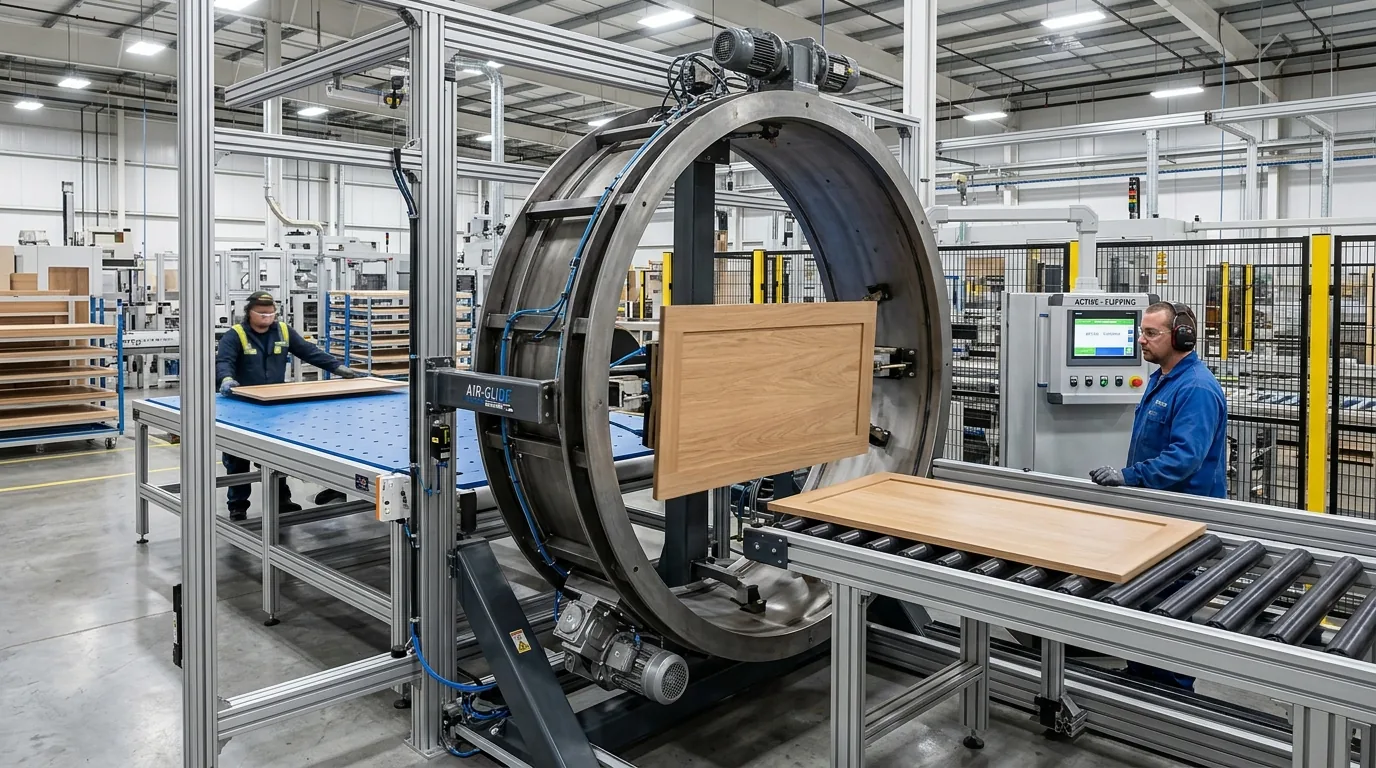
3 Core Mechanical Features of Modern In-Line Board Rotators
To maintain line speeds up to 25 m/min while protecting sanded wood fibers, industrial board rotators utilize three specialized mechanical subsystems:
1. Dual-Track Synchronized Clamping Belts
The rotator catches the exiting board between upper and lower vulcanized polyurethane timing belts. Pneumatic cylinders maintain uniform pressure across the entire panel length, preventing slippage while eliminating point-pressure dents on soft pine or cedar.
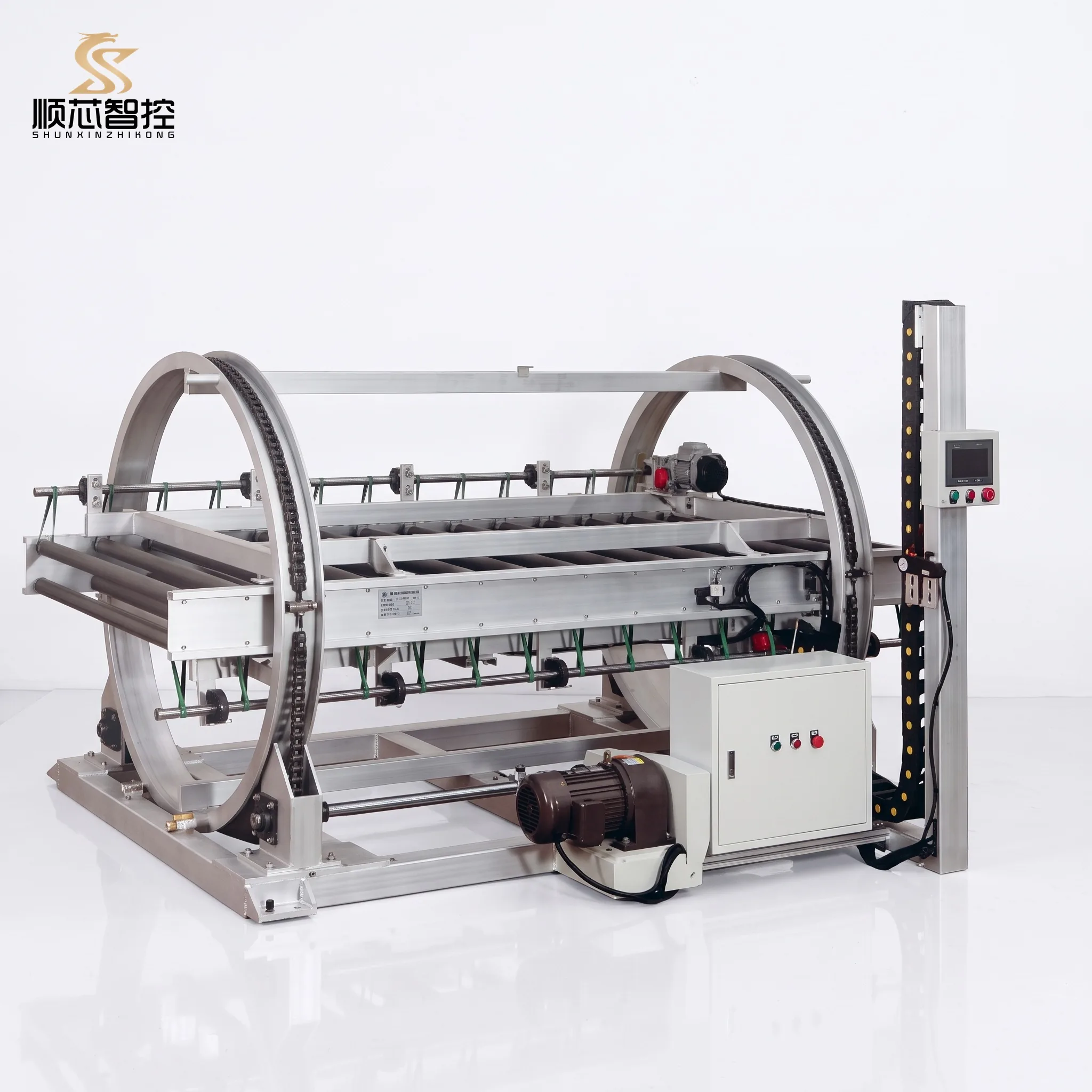
Engineered with oversized spherical roller bearings and high-tensile steel frames to rotate thick architectural panels up to 120 kg without chassis deflection.
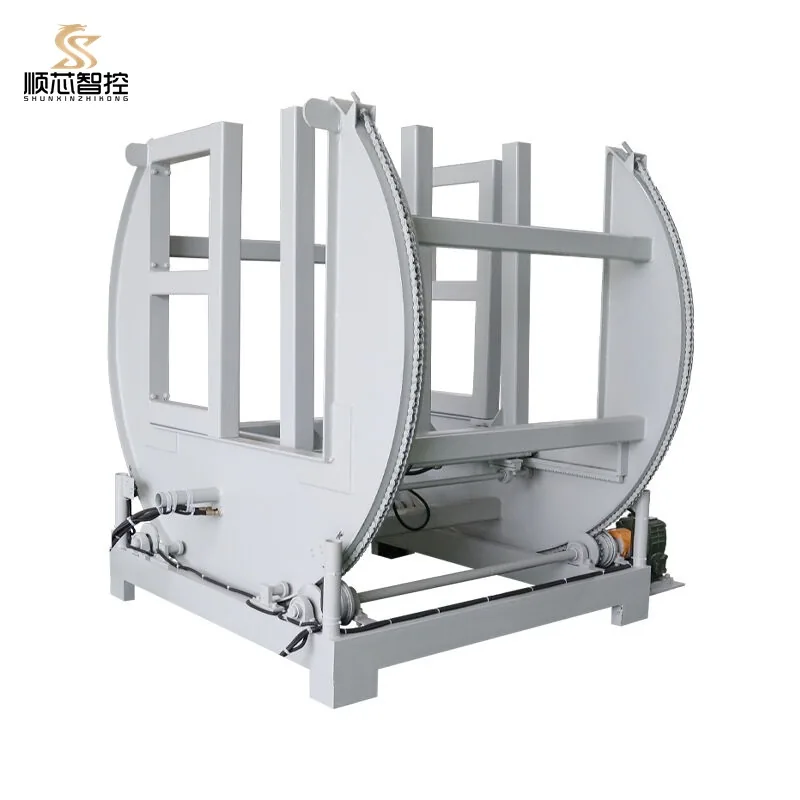
VFD-controlled brake gearmotors execute controlled S-curve acceleration, completing the 180° rotation in 10 to 12 seconds with soft horizontal landing.
2. High-Pressure Ionizing Air Blow-Off Knives
Sanders generate massive dust accumulation. Before the board enters the clamping rotator, twin high-velocity anti-static air knives blow high-pressure ionized air across both faces, stripping away loose abrasive particles that could otherwise become trapped against the turnover belts.
3. VFD Line Speed Matching & Pass-Line Registration
The rotator’s infeed and outfeed roller speeds are tied via dry-contact PLC interlocks to the sander track feed rates. The outfeed table features a motorized reference fence, aligning the newly inverted board against the second sander’s datum guide.
Technical Performance Matrix
| Operational Metric | Manual Two-Worker Inversion | Automated In-Line Rotator (SX-ST180) |
|---|---|---|
| Manpower Allocation | 2 Dedicated Workers (Heavy Lifting) | 0 Workers (100% Unmanned) |
| Double-Pass Cycle Time | 45 – 60 seconds / board | 12 – 15 seconds / board |
| Cross-Grain Scratch Defect Rate | 2.5% (Abrasive track drag) | <0.05% (Cushioned belt grip) |
| Shift Panel Throughput (8h) | 450 – 600 finished panels | 1,100 – 1,400 finished panels |
| Operator Injury Risk | High (Severe lumbar & shoulder strain) | Zero (Meets OSHA ergonomic standards) |
| Annual Labor Cost | $50,000 – $80,000 (US loaded cost) | Zero recurring labor overhead |
Global Industrial & GEO Export Standards for Sanding Lines
Industrial sanding automation must satisfy international safety, dust explosion, and electrical criteria:
GEO STANDARDS Sander Rotator Regional Compliance Matrix
- Combustible Dust: Complies with NFPA 664 wood processing dust-ignition prevention
- Safety Standards: ANSI B11.19 compliant interlocked safety perimeter fencing
- Controls: UL 508A certified panels, 480V / 208V, 60Hz 3-Phase dual-voltage motors
<div class="p-3 rounded-xl bg-slate-900 border border-slate-800/80">
  <div class="font-bold text-white mb-1 flex items-center gap-2">
    <span class="w-2 h-2 rounded-full bg-emerald-400"></span>
    European Union (CE Directives & EN 12779)
  </div>
  <ul class="space-y-1 text-slate-400 list-disc list-inside">
    <li>Directives: CE Machinery Directive 2006/42/EC, EN ISO 13849-1 Cat.3 / PL d safety relays</li>
    <li>Optoelectronic Safety: Category 4 optical light curtains halt rotation instantly on boundary breach</li>
    <li>Energy Standards: IE3 premium efficiency variable-frequency drives, 400V 50Hz</li>
  </ul>
</div>

<div class="p-3 rounded-xl bg-slate-900 border border-slate-800/80">
  <div class="font-bold text-white mb-1 flex items-center gap-2">
    <span class="w-2 h-2 rounded-full bg-amber-400"></span>
    Southeast Asia (Vietnam, Malaysia Solid Wood Hubs)
  </div>
  <ul class="space-y-1 text-slate-400 list-disc list-inside">
    <li>Power Grid: 380V, 50Hz standard Asian voltage</li>
    <li>Environmental Resistance: IP55 totally enclosed motors with anti-moisture tropicalized insulation</li>
    <li>High Payload: Heavy-duty chassis built for continuous processing of dense rubberwood and acacia panels</li>
  </ul>
</div>

<div class="p-3 rounded-xl bg-slate-900 border border-slate-800/80">
  <div class="font-bold text-white mb-1 flex items-center gap-2">
    <span class="w-2 h-2 rounded-full bg-purple-400"></span>
    Export Packaging & Sea Transit Standards
  </div>
  <ul class="space-y-1 text-slate-400 list-disc list-inside">
    <li>Packaging: Solid timber crates compliant with ISPM-15 international export regulations</li>
    <li>Anti-Corrosion: Rotating shafts and bearings coated with protective grease under VCI foil</li>
    <li>Container Efficiency: Modular structural sections fit standard 20GP / 40HQ container space</li>
  </ul>
</div>
Summary & Engineering Line Integration
Interconnecting bottom calibration and top finishing sanders with an automated 180° board rotator transforms double-sided sanding from a physically grueling manual chore into a seamless, high-speed automated pass. By eliminating worker fatigue, preventing cross-grain scratches, and keeping wide-belt sanders running at full duty cycles, factories achieve immediate payback and superior surface quality.
Contact our sanding automation specialists today with your sander brands, panel dimensions, and daily output goals to receive custom 3D integration blueprints and an itemized export quotation.
All automated loop return procedures and electrical sensor alignments must adhere to standard workshop lockout-tagout (LOTO) protocols and host machinery manufacturer guidelines. Shunxin equipment includes universal dry-contact interlocks to ensure immediate emergency stop response across synchronized production lines.
Need a Custom Layout Drawing & Quotation for Your Workshop?
Send us your workshop dimensions or CAD floor plan. Our mechanical engineers will deliver a synchronized layout proposal and payback calculation within 24 hours.